
AURA Review doesn't comment. It decides.
Code review with a verdict: every Pull Request gets 0 to 100 across four criteria and an explainable decision — approve, comment, request a manual test, or block. Based on your policies, your CI evidence, and the spec that originated the change.
GitHub App · First verdict in under 10 minutes · No card · 25–35% cheaper than the leader
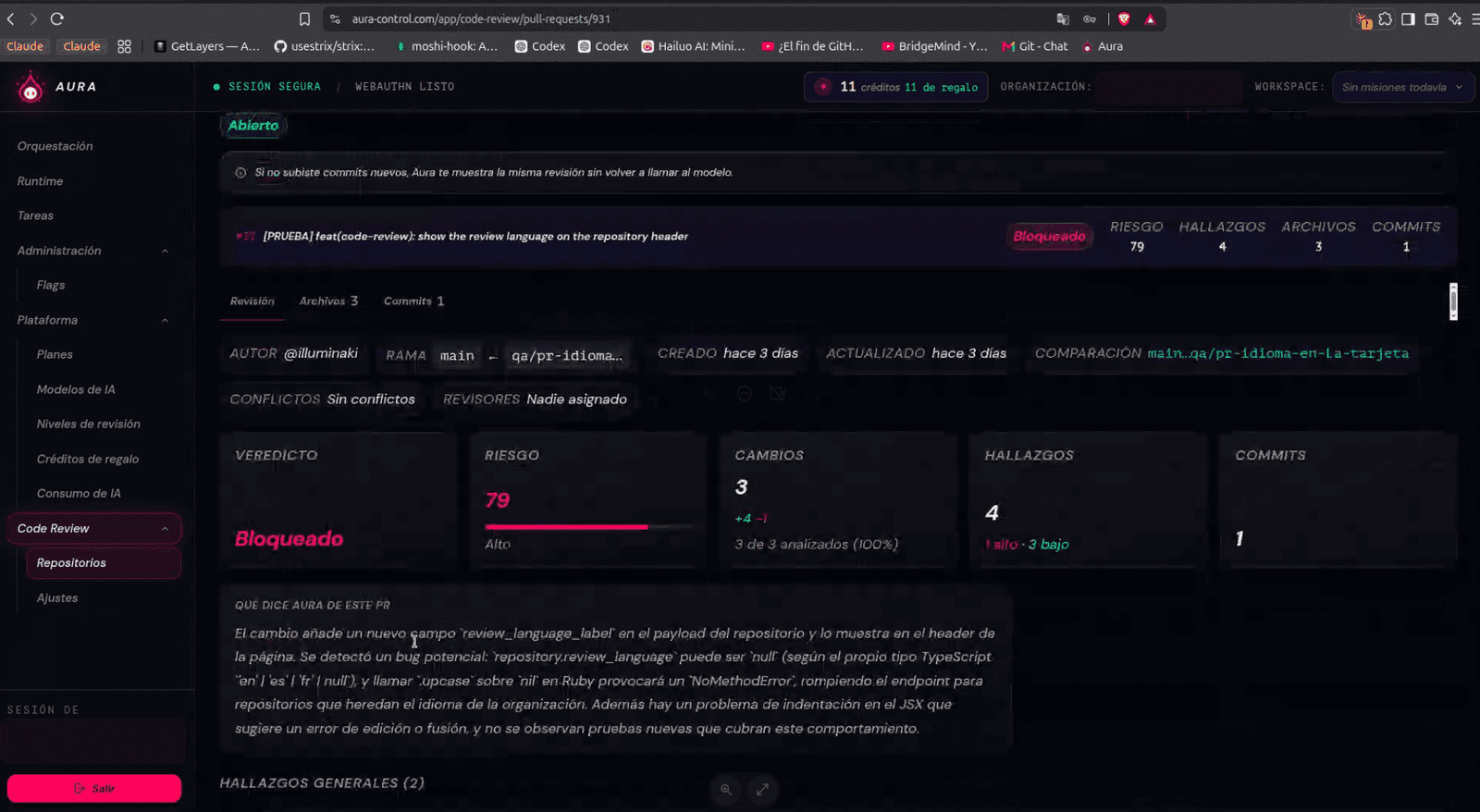
From a webhook to a decision, in nine stages.
Ingestion, repository profile, checks, CI evidence, findings normalization, AI analysis, policy decision, reporting, and recovery. Fully automatic, where your team already works.
1 · Connect your repository
Install the GitHub App and choose the repos. AURA inherits your branch protection and permissions. The .aura/config.yml file lives in your repo: your rules are yours and versioned.
2 · AURA analyzes every PR
It reads the change, system context, and CI evidence (SARIF, JUnit, coverage). If the PR carries an AURA spec tag, it inherits that specification and verifies that what was asked for was done.
3 · Verdict and decision
A 0–100 score, findings per criterion with file and line, and your policy decision: approve, comment, request a test, or block. Published as a GitHub check, with a summary anyone can understand.
Four questions no linter answers alone.
Compares the change against the linked spec, new tests, or the instruction that generated it. A PR can be technically perfect and still miss the ticket. AURA catches that.
Critical paths, modules it shouldn't touch, symbols that don't exist, callers that break. The typical failure mode of agent-generated code.
Your own stack's linters, coverage, types, maintainability, KISS and DRY. With normalized CI evidence, the same yardstick for any language.
Exposed secrets, dependencies with CVEs (via Dependabot), injection patterns, personal data in logs. And with the add-on, continuous monitoring after merge.
Your rules, versioned in your repository.
A single file declares what is critical, what gets blocked, what needs a manual test, and when auto-merge is allowed. It is reviewed in a PR like any other change, and if it has a syntax error AURA uses the last valid version instead of stopping the review.
- Per-repository thresholds
- Critical paths and paths that must not be touched
- Exceptions by author, branch, or label
- Auto-merge with conditions: risk, size, days, and hours
- On Enterprise: industry templates and organization inheritance
# .aura/config.ymlstack: railsrequired_checks: [ci/tests, ci/lint]critical_paths:- "app/services/payments/**"- "app/controllers/auth/**"must_not_touch:- "db/migrate/**"policies:thresholds:block: 75manual_test: 40auto_merge: 20auto_merge:enabled: truemax_diff_lines: 200allowed_days:- mon- tue- wed- thu # nothing on Fridaysexcluded_paths:- "app/services/payments/**"
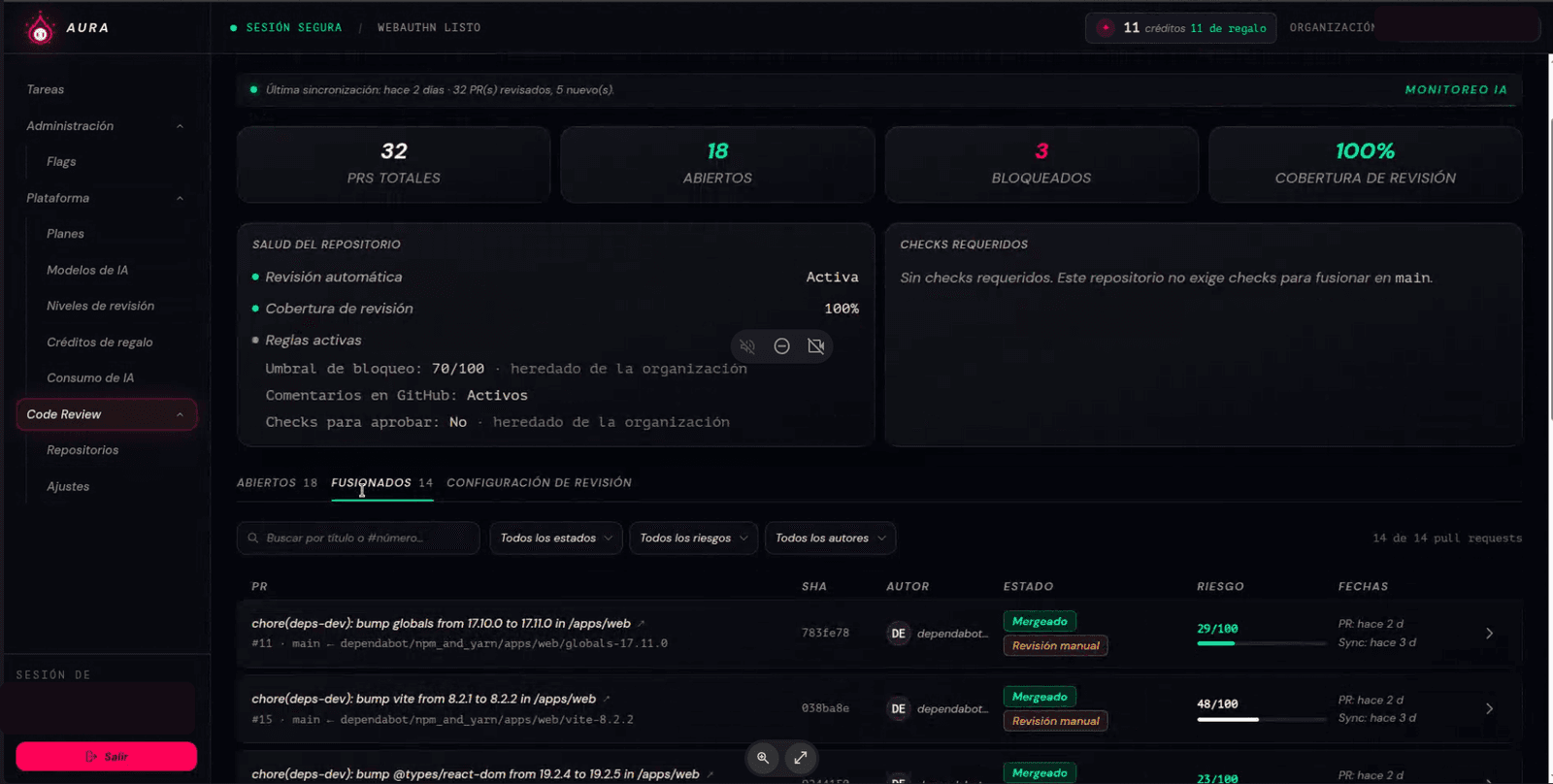
A dashboard that answers “how are we doing?” without opening a PR.
Total, open, and blocked PRs; review coverage; active rules and where they come from (own or inherited from the organization); required checks to merge. The view a tech lead checks once a day.
- Block threshold inherited from the organization
- Re-review cache: with no new commits, the model is not called again
- Filters by status, risk, and author
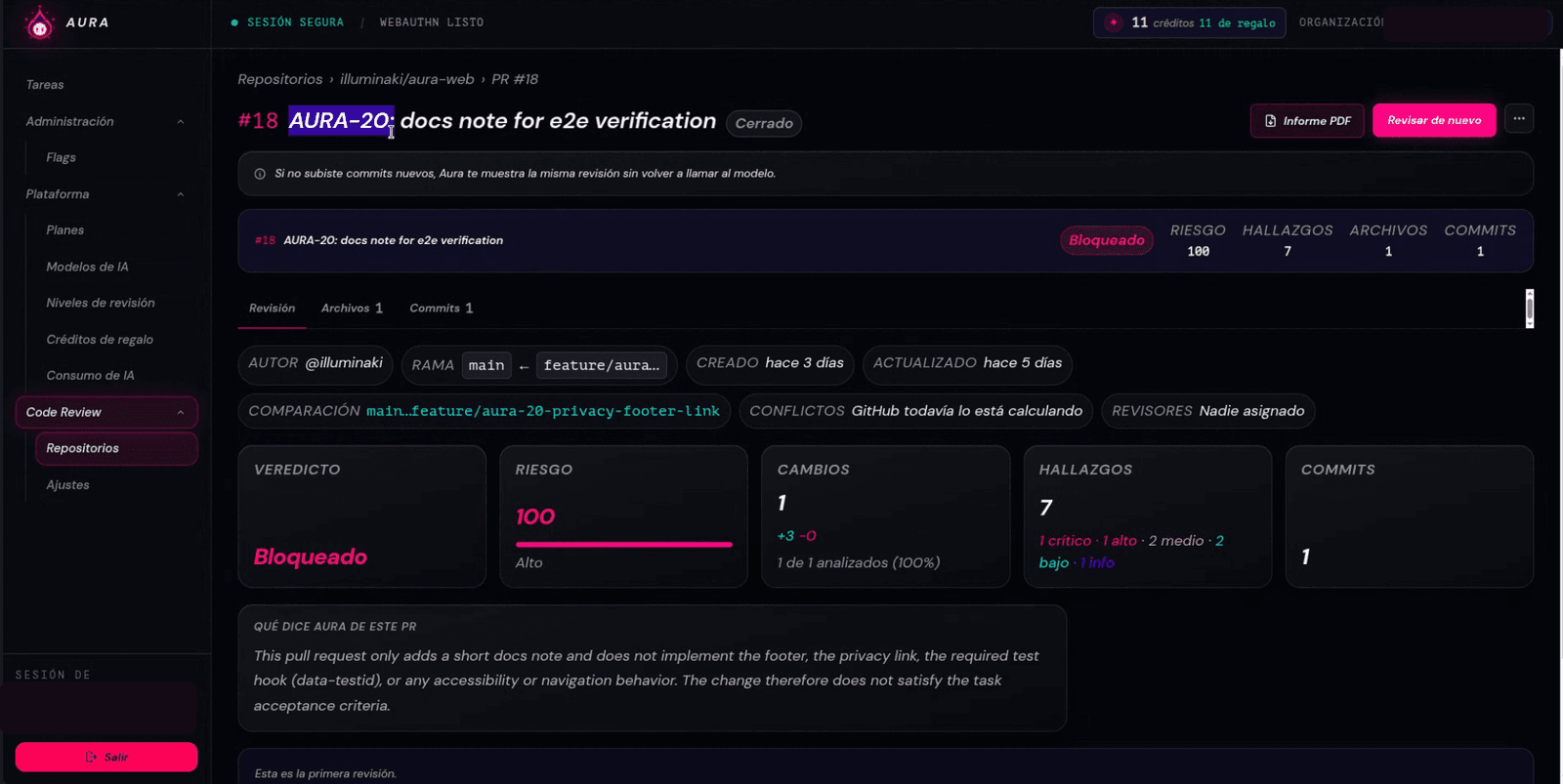
Evidence your CTO and your client understand.
A monthly PDF — and on demand per PR — with KPIs, risk trend, ranking by repository, security findings, AI costs, and control accuracy: how many times a human corrected AURA. We publish our own mistakes because that is the only way you can trust our hits.
- Natural-language narrative for people who don't code
- Audit annex with every PR, verdict, and applied policy
- White-label on Enterprise: the quality evidence a factory delivers to its client
You don't pick the model. AURA picks the right one for each change.
Three tiers — basic, standard, and full — and automatic routing by risk: we don't spend an expensive model on a button color change, but we do on the payments module. On Enterprise you choose: model, geographic region, or bring your own.
Basic tier
For quick comments and re-reviews with minimal changes. Included from Free.
Standard tier
The workhorse: most Pull Requests. A model mix calibrated with production data.
Full tier
Activates only when it matters: critical paths, large changes, high risk detected, or when the author asks. Generous quota on Pro.
One stage of the cycle, compared honestly.
| Capability | AURA Pro | CodeRabbit Pro | Copilot code review | Greptile |
|---|---|---|---|---|
| Price | ||||
| Per developer / month (annual) | US$19 | US$24 | US$39 (bundle) | ~US$30 |
| Permanent free plan | Yes | 14-day trial | No | No |
| Decision | ||||
| Verdict that blocks merge by policy | Yes, 0–100 | Partial | No | No |
| Intent criterion (did it do what was asked?) | Yes, from the spec | No | No | No |
| System coherence criterion | Decides | No | No | Comments |
| Configurable auto-merge | Yes | Basic | No | No |
| Control and trust | ||||
| Model and region choice | Enterprise | Fixed | Fixed | Fixed |
| Published control accuracy | In the report | No | No | No |
| Executive PDF report | Included in Pro | No | No | No |
| Part of a full cycle (Spec, Runtime, Orchestra, QA) | Yes | No | No | No |
Comparison based on each product's public docs and pricing as of September 2026. If any figure is outdated, write us and we will correct it the same day.
Before you connect your first repository
AURA doesn't police anyone: it normalizes using AI to build software and helps verify that it turned out right.
No. It multiplies what they can govern. AURA only approves what meets the policy your team defined and focuses human attention where it is truly needed. Reviewers stop reading everything and start reading what matters.
Anyone with permission can correct it in one click. The event is logged and control accuracy is published in your monthly report. If we are wrong more than 5% in a repository, that is our incident and we adjust thresholds.
Nothing bad. AURA never stops responding or blocks a merge because of quota. At 80% we warn you; at 100% review continues at the standard tier. If you want to keep the full tier, the credit wallet covers it. Your plan is consumed first, then bonuses, and only then what you purchased.
Name the branch or PR title with the spec tag (for example AURA-118). AURA inherits the specification and verifies the code does what was asked. It works the same with Jira tickets once import is connected.
Today with GitHub. GitLab arrives in Q2 2027 and Bitbucket in Q3. If your team is on one of those platforms, write us: we prioritize by real demand.